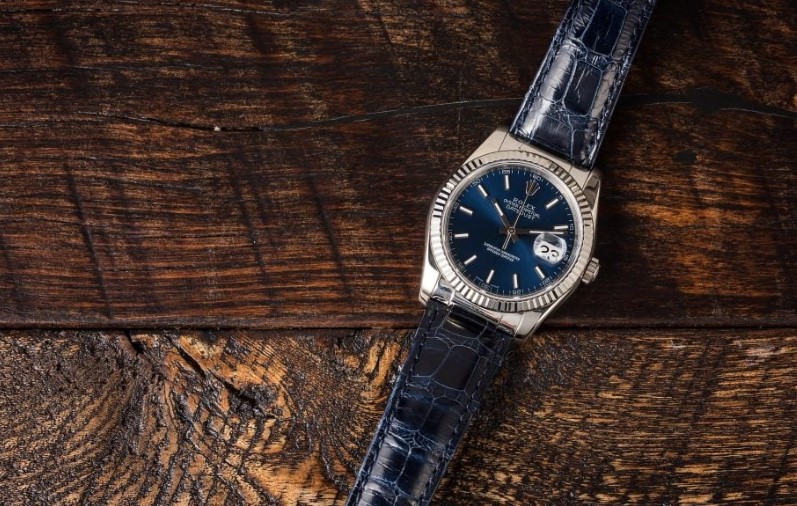
In our article on investing in rare and vintage Rolex watches, we made a point that has become a cornerstone for any serious collector: “While brand new hands or dials may appear beautiful and desirable initially, the original pieces of the watch determine its true value. Collectors seek originality above all other considerations.” At first glance, this statement might seem like common sense. After all, originality is a hallmark of value in almost any collectible market, whether it’s art, cars, or replica Rolex watches UK. Yet, over the years, a paradox has emerged in the world of Rolex: the very company that produces these iconic timepieces has systematically worked to diminish the originality of its vintage models, undermining their value in the process. This has been done under the guise of providing “official” servicing, a policy that, while ensuring the functional integrity of the watch, often comes at the expense of its original components.
Rolex’s official stance on servicing is straightforward, as outlined on their website: “To guarantee continued accuracy and waterproofness, Rolex recommends that you periodically return your watch to an Official Rolex Jeweler or Service Center for professional servicing. It is recommended to service your Rolex approximately every 10 years, depending on the model and real-life usage. When your watch is serviced by Rolex, the watch is completely dismantled and all of its components are ultrasonically cleaned. Each individual component is closely examined, and those that no longer meet Rolex’s functional and aesthetic specifications are replaced with genuine Rolex parts.”
At first glance, this sounds like a perfectly reasonable approach to preserving a Rolex watch, ensuring that it remains in optimal working order for generations to come. Rolex watches are known for their precision, robustness, and timeless appeal, and it’s understandable that the company wants to uphold these qualities in every piece it services. However, the devil is in the details, particularly the last line: “those that no longer meet Rolex’s functional and aesthetic specifications are replaced with genuine Rolex parts.”
This seemingly innocuous statement carries a hidden cost for vintage Rolex owners. For highly-prized vintage AAA+ clone Rolex watches, particularly those with unique components, worn patina, or specific characteristics that make them rare and valuable, this policy can be disastrous. When Rolex replaces parts on a vintage watch, it’s often not just a matter of maintaining functionality—it’s about transforming the watch into something that looks and feels brand new, often at the expense of its originality. This can drastically reduce the value of a rare, vintage timepiece. The very components that collectors prize—the worn dial with a charming patina, the faded hands, or the original lume—are often discarded in favor of pristine, factory-fresh replacements.

One of the most obvious examples of this “service intervention” is the concept of the “service dial.” A service dial is essentially a replacement dial installed by Rolex or an authorized service center when the original dial has become damaged, worn, or faded beyond acceptable standards. While this may sound reasonable from a practical standpoint, it’s a nightmare for collectors. A service dial may look brand new, but it is not the same as the original dial that came with the watch. The material used may be different, the design may not match the original specifications, and, most importantly, the patina that often adds character and uniqueness to vintage perfect fake Rolex watches is lost.
Perhaps more controversial is Rolex’s decision to replace dials on models that contain radioactive material such as radium or tritium, which were used for luminosity purposes. These materials were phased out over time in favor of safer alternatives like Luminova and SuperLuminova. As a result, if a vintage Rolex with tritium lume is sent in for service, the original dial will be swapped out for one with the newer, non-radioactive lume. While this may be a necessary safety measure, it can render the watch much less desirable to collectors who value the original aesthetic and historical accuracy of the piece.
Imagine sending in an ultra-rare vintage Rolex with a faded, tropical dial—one of those dials that has developed a unique and sought-after color over decades of exposure to sunlight—only to have it return from the service center looking almost brand new, with a fresh, modern dial that lacks the same character and value. For many collectors, this is a devastating outcome, as the watch is no longer the same in both form and value. It might still work as a timekeeping instrument, but its originality—and by extension, its collector’s value—has been significantly diminished.
The issue of service dials is not a simple matter of replacing a damaged part with a functional one. For collectors, the authenticity of a vintage Rolex watch is paramount. A service dial may be an official, genuine Rolex part, but it is no longer the original part that came with the watch when it left the factory. The difference between an original dial and a service dial can be subtle, and sometimes not-so-subtle, depending on the model. For example, vintage cheap fake Rolex watches like the GMT-Master 1675, produced from 1959 to 1980, or the Submariner 1680, produced from 1967 to 1980, are particularly vulnerable to these service dial replacements. When these watches are serviced, they are often returned with dials that feature SuperLuminova lume, which doesn’t age or acquire patina the way tritium did. This can drastically alter the watch’s appearance and value. Furthermore, service dials may lack markings such as the “SWISS t < 25” inscription found on the original tritium dials, signaling that the lume contains radioactive material.

From a collector’s perspective, distinguishing between an original dial and a service dial is crucial. While some service dials may be nearly identical to the originals, others are completely different and easily identifiable. For example, a vintage Submariner with a tritium dial will appear distinctly different from a serviced Submariner, where the lume is completely new and different in texture and color. The difference may not be immediately obvious to the untrained eye, but to a seasoned collector, it’s clear.
Moreover, collectors who focus specifically on vintage Rolex watches often make a further distinction between service dials and service-only dials. A service dial is one that could have been used as an original part on a watch but has been replaced during servicing. A service-only dial, on the other hand, was never used on a watch originally but was produced solely for replacement purposes. Depending on when the watch was serviced, the dial may feature tritium, Luminova, or SuperLuminova lume, depending on the period of replacement.
Rolex itself often fails to make a distinction between original dials and service dials, which can be problematic for collectors who view these service dials as inferior replacements. For example, Rolex’s official books on models like the Submariner feature many examples of service dials, despite the fact that they are not the same as the original components that came with the watch. This can lead to confusion among collectors, who may mistakenly assume that these service dials are just as valuable as original parts.
At the end of the day, the value of a vintage Rolex lies in its originality. While a serviced Rolex may perform as well as new, it is not the same as an original, unaltered piece. As a collector, it’s important to be aware of the impact that official servicing can have on the value of a vintage watch. Ultimately, however, the decision is yours. If you intend to keep the watch for personal enjoyment, the authenticity of the dial may not matter as much. But for those who view their copy Rolex watches for sale as an investment, or who appreciate the history and craftsmanship of a vintage Rolex, maintaining originality is key.