It’s funny how “everything Rolex” works — and that includes opinions. If I were to praise it, I would be told I drank too much of the Crown’s Kool-Aid. If I criticized it, I am a hater “who doesn’t get it.” Well, here we go, anyway. I remember the moment I first took the best replica Rolex Yacht-Master 42 watches in RLX Titanium into my hands and immediately thought, “This… feels and looks… wrong to me.” Worse, it felt cheap, despite being anything but: This Rolex 226627 was priced at $14,050 when it debuted in 2023, which has since risen to $16,050. Oh, and what’s with that extra $50?
First, one more disclaimer. I have had the privilege of good fortune to save up for and afford a luxury watch — and I spent my hard-earned money on a Rolex (after having sold my Jaeger-LeCoultre Master Compressor Navy SEALs Automatic and my Grand Seiko Spring Drive SBGC001, one of, I believe, the best watches ever made). I wear my current watch with no small expectations, such as that it’ll work well throughout my entire life as my daily, if I want, will have an infinite supply of spare components for half a century or more, and will forever be recognized (by me, which is what I care about, but perhaps also by others) as one of the all-time greats in watchmaking. Some folks hate Rolex, others hate the watch I chose, and that’s all good. Others still will flock toward this YM42 and wear it with pride and joy — and, at the end of the day, I am happy if they are happy. However…
I want to revisit this particular watch again, reference 226627, because it is a rarer-than-rare thing from Rolex: a fluke. It’s as close to being objectively bad as something as subjective as a luxury watch can get. Oh, and also because I wrote 4,000 words comparing this particular watch with a $600 fake version, and I thought it a good idea to first focus on the original in a dedicated article. You know, some more words and photos for you to digest before digging into the Big Fake Comparison article that we will publish soon.
That said, here’s the deal, as I see it after much contemplation, about the Rolex Yacht-Master 42 in RLX Titanium. Upon its debut, it was the second-ever production watch in titanium from Rolex, following a few publicly spotted prototypes. On the shelves, it was only preceded by the laughably unwearable Deepsea Challenge in the same metal — and by the Citizen X-8 Chronometer, which was the first-ever titanium wristwatch to be debuted.
I’ll let you have an educated guess. 2000? 1990? 1980? 1970. Half a century before Rolex went anywhere near this comfortably wearable, lightweight, corrosion-resistant, hypoallergenic material. In the time that passed between Citizen’s X-8 and Rolex’s Yacht-Master 42, titanium watches have become widely and affordably available from low-, mid-, and top-tier Swiss and Japanese brands. Swiss copy Rolex watches is well past the point where it needs to be first with anything — it was late to the large watch trend in its entirety, the ceramic party, the elastomer strap party, the “revival of the integrated bracelet” party, and the list goes on. And while Rolex can afford to be all those things, generally speaking, when a company that constantly praises itself and yet is this late, it has to deliver, and it must shock and awe. If it falls short of all those, it must at least impress. This is Ferrari’s — one of many — struggles with its first electric car, the Luce, and Audemars Piguet’s — one of many — struggles with the Code 11.59. But I digress.
Long-term high demand was matched with a more or less idling product portfolio at Rolex, Audemars Piguet, and Ferrari. This is not to say there weren’t many individually impressive offerings, just that they were mostly continuations of long-existing recipes. This, compounded with mass demand, public attention, an onslaught of excessively lofty statements, self-aggrandizement, and condescension (looking at you, AP, on that last one). The emperor had claimed to have put on all these fancy robes and gotten absolutely ripped underneath them. As it goes, when the emperor shows up naked and with the aesthetics of an inflated diving suit, the myth falls apart. “The emperor had never hit the gym!” (Gasp!)
Well, for Rolex, the gym would be the R&D department. And I’m not sure the Yacht-Master 42 in RLX Titanium has any idea which floor that department is on, inside the maze-like building of the Rolex HQ, where there is such a thing as “the elevator treatment.” Kid you not. Had it. Miss it. Think of it often. Titanium is a material that poses numerous challenges. It has to be machined, finished, assembled, constructed, and approached differently from stainless steel, a material the UK 1:1 fake watches industry — including Rolex — has vastly more experience with. This is largely why De Bethune and, indeed, Grand Seiko have received all that glowing praise for finishing it to their outstanding standards.
I do not recall there being a repeated (or any kind of) public request for Rolex to embrace titanium other than perhaps from the “yeah, that’d be cool” crowd. In other words, Rolex had half a century, and then some, to fine-tune it to a level that matches not only Rolex’s “Superlative” standards (in line with its “perpetual quest for excellence,” a mantra that has indeed helped it to unparalleled and unrivalled achievements in other fields such as the largest scale production of highly accurate luxury watches) but also those of the greater industry.
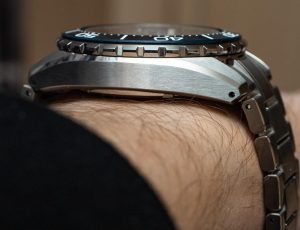
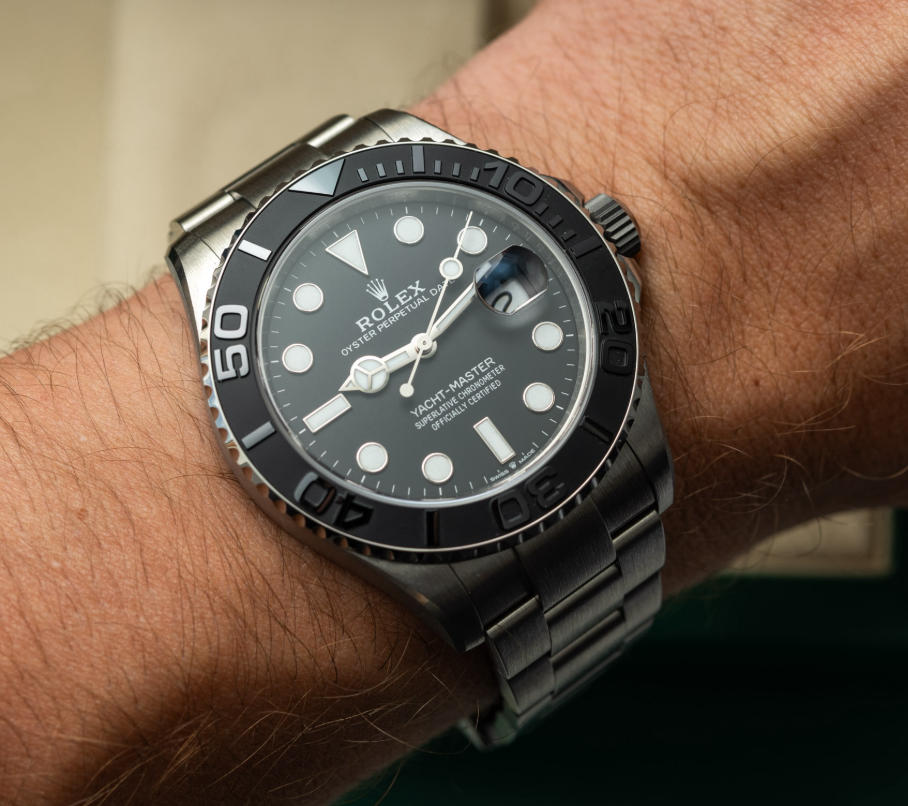
Perhaps the strongest summary of my gripes with the Rolex Yacht-Master 42 in RLX Titanium is the image above. If I put my hand on my heart, I must say there is nothing on that picture, and therefore on that watch, that I would find acceptable at $16,050. Not one detail, engineering decision, or execution. Let me explain. First, look at the wonkiness of that bevel running along the corner edge of the lug. If this were an early prototype (!) of a $750 (!!) Kickstarter (!!!) dive watch brand, and they asked for my feedback, I’d tell them this is probably not going to fly with the community. Specifically, that bevel fails to create a sharp edge on either of its peripheries. It’s as soft as butter you sliced into 3 minutes ago. Then, the bevel’s overall width varies randomly and fails to create a well-defined, even surface. The shape it follows is as though it were taken from an early sketch. Last, look at what Grand Seiko can do with titanium: sharp as a blade. Costs $12,400, with Spring Drive to boot (one of the few calibers that can truly rival those of Rolex, in my book).
I have never done this before, but this time, I will keep on inserting this exact same image repeatedly as I keep describing bits of it because I don’t want you to have to scroll too much up and down — and because I want you (and Rolex) to see it. The roughness of the brushed case profile beggars belief, even as a deliberate design choice. If someone had done this for fun to a Rolex after they had destroyed it in a scooter accident in Monaco, I’d say, “Sure.” They had no idea what they were doing; the watch had a tough life, and it now has the finishing to match. This is how far I have to stretch my imagination to land on the first constellation of plausible scenarios where this finish could land on a $16,050 watch. Is this machine-made? Or by hand? Does that matter at all at this stage? Not to me, because neither would be a redeeming quality.
I would be genuinely interested to know if Rolex looked at this and thought that this was supposed to impress prospective customers and existing collectors. If this (look at it) fits into a universe of luxury. Rolex excels at fabricating stories that help separate its products. The top clone Rolex Yacht-Master watches, for example, belongs to the Professional category of watches (the other is Classic) but is not a dive watch. It decidedly does not have a depth rating label, nor a uni-directional bezel, both requirements of a true dive watch. This bezel rotates bi-directionally so that the wearer can measure the sailing time, no less, between two buoys. Bah! What nonsense. I am not sure if Rolex has ever properly illustrated or demonstrated this use scenario; it seems so hellbent on over-emphasizing it so often. More to the point, Rolex has never attempted to create a story that would help explain or at least justify the roughness of this execution on titanium.
I’ll submit you to this image one last time. Look at the links, specifically their edge. That rough brushing simply wraps around it as though this was a link from an expensive bike lock chain. Calling it “industrial” is only the beginning of the issues we are facing. The links appear soft as a jellybean, with a shape as well-defined as one of those, too. There are random gouges that run along their profile, but also the corner where the two planes meet. This is a part of the link that, on luxury watches, is often bevelled and then polished to create a neat separation of these two surfaces and also to successfully create expensive-looking reflections that run along the edges of the entire bracelet. Maybe applying those gouges and rough brushing to the corner-edge is challenging — sadly, we would never know, as Rolex does not appear to have shared much about the process(es) with which it treats RLX Titanium.
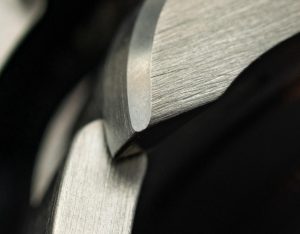
I lied. Here is this picture once again. I wonder, apart from those who genuinely like the way this surface treatment looks, are Rolex customers blind, stupid, or careless when they buy this watch? By the way, this particular piece is owned by a friend who owns virtually every desirable Rolex watch you can think of in every metal and dial combination you can possibly name, and I hope he will humor me by asking those questions. I know he couldn’t care less; he owns one or more of each. It is also a factory-fresh piece that has never been worn. Is it me who has some sort of an odd eye defect that has me look at this and find it unacceptable? I — as a Rolex owner — could not live with myself had I paid $1,605.00 for this execution, let alone $16,050. But the point is not what it is that I like or dislike. The point I want to make, or at least ask, is whether or not this is as close to “objectively bad” as we have gotten in a long, long time in the largely subjective world of luxury watches?
Allow me to bang on a bit about Rolex’s approach to titanium. I looked up the product site of this YM42, and also the only PDF I could find on Rolex’s “Newsroom” to try and find every bit of official communication as to why and how Rolex chose and uses this lightweight metal. The blurb goes: “RLX titanium is a grade 5 titanium alloy specially selected buy Rolex replica watches.” To me, “specially selected” does not mean anything. If I go to a restaurant and specially select the ossobuco with saffron risotto (great dish, by the way), that does not mean I had anything to do with its creation. I just “specially selected it.” I am not saying there cannot have been more to this story, but as it stands, that is meaningless high-speak from Rolex.
Rolex goes on: “Another characteristic of RLX titanium is the possibility of working it to give a polished or satin finish according to the brand’s specifications. Its high mechanical strength makes it complex to work with, and the decision to use it has required the introduction of special production processes.” What’s difficult to understand for me is how the end result is actually neither of those — it’s not polished, nor satin. Here is something very fascinating (as fascinating as a dry description of a watch can be): “The chamfered top edges of the middle case lugs have a high-sheen finish, while the crown guard is polished.” In what world is that chamfered surface a “high-sheen finish?” There are not enough photons in this universe that you could blast at that lug and make it “high-sheen.”
What’s really interesting is that on Rolex’s official photos, these edges do appear almost mirror-like, with a deeper, underlying sheen. Now, compare that to the picture I subjected you to a number of times already, noting that my picture was also taken with a powerful flash lighting up the scene. More confusing still, Rolex does not say another word about those “special production processes.” Other companies create 3-30 minute-long videos, actual documentaries, beautifully presenting how they make a single dial, case, or other component. Cheap copy Rolex watches is understandably secretive about its production methods and indeed facilities — you can get 1-3-5 frames (that means fractions of a second) worth of a glimpse into certain machines and departments when watching select official Rolex videos. They are there, but you have to view the videos in slow motion, frame-by-frame, and do some pixel-hunting to see where your five-figure watch was made. Or not even that, since we are not shown anything whatsoever pertaining to Rolex’s RLX titanium.
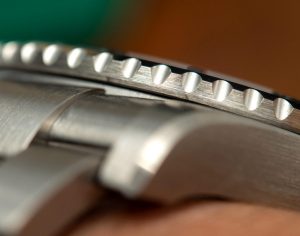
Viewed from the side, this bezel looks like an unfinished component to me. Having had all this therapy writing, I can go past the rough finishing… Only to discover that we can very clearly see the machining marks left by the drill that created the scalloped holes for better grip and design. Rolex can do such a wonderful job with its fluted bezels — they look mighty expensive, precisely made, and highly refined, as the various laser-sharp edges and mirror-flat surfaces scatter light everywhere. Sure, fluted bezels have been exclusively crafted from 18k gold and more recently also from platinum, but this clearly machine-made bezel reflects virtually none of that know-how and attention to detail. Ideally, these rounded indentations should have been more refined, maybe fully polished, in case that worked with the overall design. As they stand, all I see is a “finished” part that entirely reminds me of my many watch manufacture visits, where I was allowed to pick up random parts idly sitting between different manufacturing steps. This just looks literally unfinished to me.
On the wrist, the perfect fake Rolex Yacht-Master 42 watches in RLX titanium feels light yet solid, large yet comfortable. It has a rather extensive footprint and a top-heavy appearance, given the relatively narrow Oyster bracelet and its strong taper toward the Oysterlock clasp. It brings all the wearing comfort that titanium offers and uses it wisely and extensively, complemented by a relatively thin, 11.7mm case thickness. Well done. As I said, it is not a full-on dive watch and, despite its dive watch-like aesthetics, it only has a 100m depth rating, a third that of the similar-looking Submariner. Perfectly fine for just about every use scenario, especially since it is combined with the more robust Triplock crown. I wouldn’t be surprised if this package easily passed 200m, maybe even greater pressure tests — but try that at your own risk.
Still, I can’t help but look at the Yacht-Master 42 as a fluke from Rolex. Even with its fantastic 3235 caliber, 5-year warranty, mighty impressive -2/+2 second accuracy rating, light weight, and decent wearing comfort, it just does not look, nor feel like a good $16,050 watch should look and feel like. Not even close. And I am sorry, but brands — even Rolex — will have to step up their game soon and by a considerable margin. Why? Because, first, I hope to believe bezels with machining marks and wobbly bevels won’t fly with luxury watch customers for much longer, and especially not on oddball, fringe releases which this Yacht-Master 42 absolutely is by Rolex standards. Second, fake makers have not been resting on their laurels… Believe you me, they have not. More on that to come tomorrow, so stay tuned and return to aBlogtoWatch.